Lecture 3
Fall 2006
Cycles and Times
Key Concepts:
- How are time and calendar defined by the apparent motions of the Sun, Moon, and stars ? ("day", "month", "year")
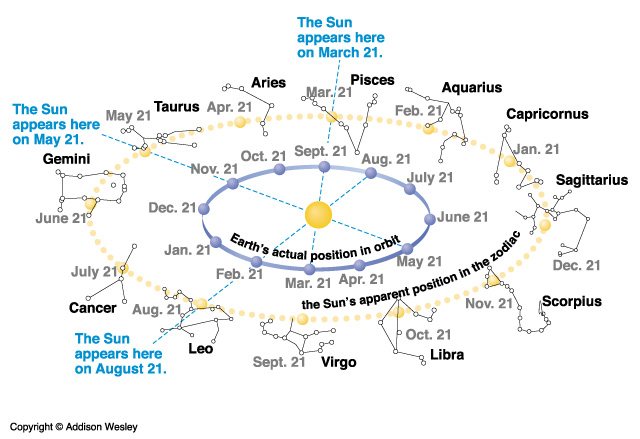
- How do the annual motions of the Sun (through the zodiac) affect our lives?
- Why do we have seasons on Earth?
Daily Motions and Time
- Think of the 24 hour rotation period of the Earth, but we dont measure this.
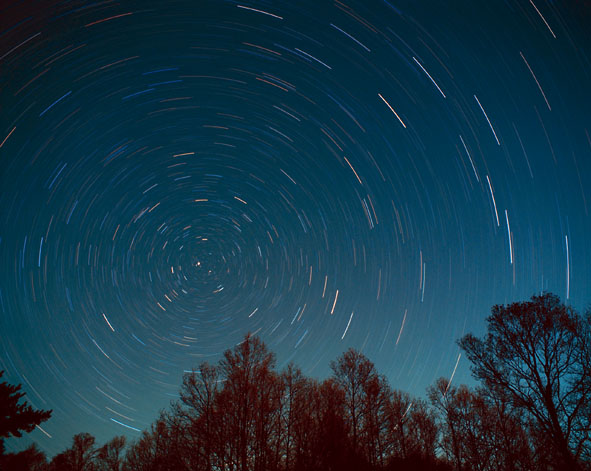
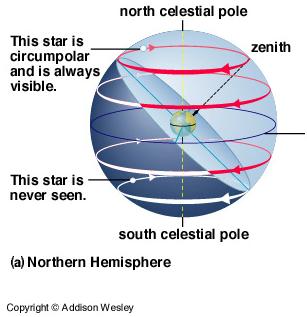
- What we see is the celestial sphere and all the objects in it which appear to be rotating around us.
- Start a stopwatch when a particular star is on the meridian, then stop the watch when the same star is on the
meridian the next day - sidereal day.
- Sidereal means relative to the stars.
-
- Use a stopwatch and measure the time for the consecutive crossings of the meridian by the Sun -solar day.
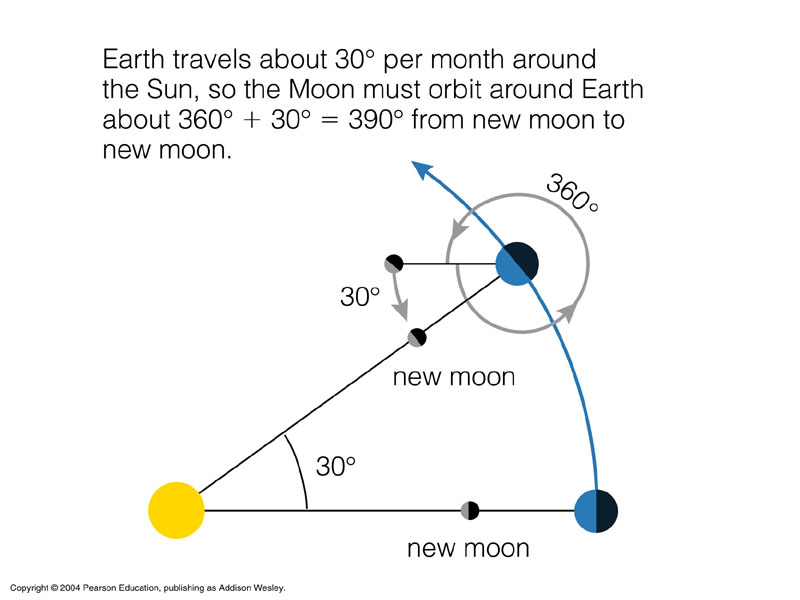
- Moon phases have a cycle. Time between new moons is roughly 29.5 days and is called the synodic month.
- Sidereal month - moon returns to its position relative to the fixed stars.
- Sidereal year - time it takes for Earth to complete one orbit relative to the "fixed" stars.
- Time between successive spring equinoxes is the tropical year.
- Sidereal day (23 hrs 56 min) vs. solar day (24 hrs)
- Sidereal month (27.3 days) vs. synodic month (29.5 days)
- Sidereal year (365.25 days) vs. tropical year (20 minutes less, because of
Earth precession)
- Modern calendar based on the tropical year - time from one spring equinox to next
- Because the year is defined to be 365 days and the sidereal/tropical years are about 365.25 days, Julius Caeser introduced the concept of a leap year.
- A year also depends on your planet: 88 days on Mercury, 225 days on Venus,
about 2 Earth years on Mars, and about 250 Earth years on Pluto!
Nowdays time really kept by "atomic clocks" using properties of atoms.
The International Earth Rotation and Reference Systems Service in Paris compares
atomic clock time which does not change and time measured by Earth's rotation which can change.
Sometimes, "leap" seconds etc added to atomic clock time to keep them in
sync with solar time.
Earth's rotation gradually slowing down but in 1999, it speeded up a bit!
At the end of 2005, a leap second was added to atomic clock time to keep it in sync.
Some scientists claim that the Tsunami at the end of 2004 in Indonesia changed the Earth's plates and its shape
and shortened the day by fractions of a second.
Annual Motions and Zodiac
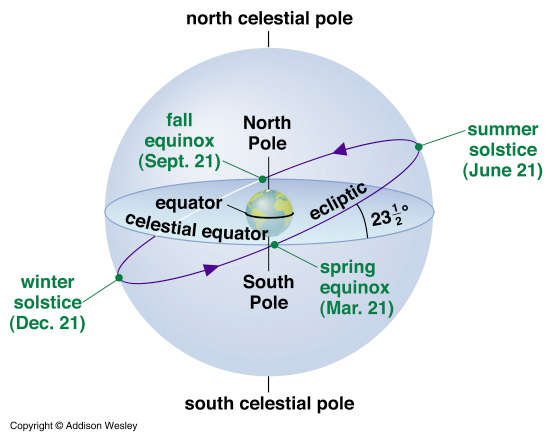
- Ecliptic: path of Sun on the celestial sphere
- Fall and Spring Equinox
- Winter and Summer Solstice
- Tropics of Cancer (north) and Capricorn (south)
- Quiz 3A: Walking with no shadows:
- Zodiac: the constellations on the celestial sphere through which the ecliptic passes
Seasons on Earth
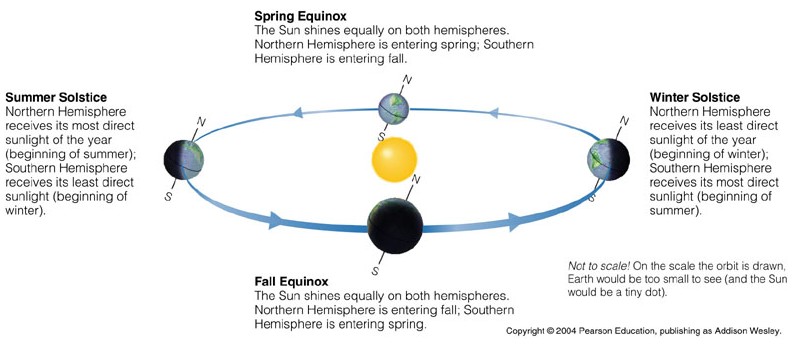
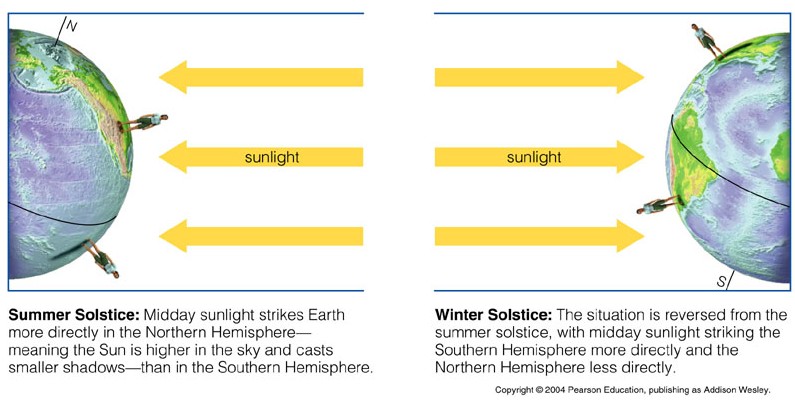
- The tilt of the Earth rotation axis by
about 23.5 degrees changes the angle of the sunbeam and thus the
intensity of the sunlight at different seasons.
- The change in the distance between the Sun and
the Earth has little to do with the seasons. The Earth is
actually slightly closer to the Sun during the winter in the northern
hemisphere.
- Quiz 3b: Seasons on Jupiter
Reading assignment for next lecture: Chapter 2 (p.41-p.53)