Lecture 7
Fall 2006
Light and Matter
Key Concepts:
- How does light interact with matter ?
- What is thermal radiation and what is spectral line (discrete) radiation?
- What are their similarities and differences?
- What is Wien's Law? and what can you learn from it?
- What is Doppler shift and what does it tell us?
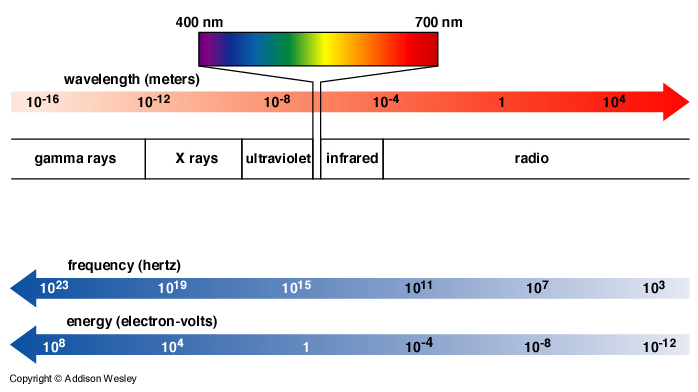
Interaction between Light and Matter
- Emission: a photon is produced by a medium
- Absorption: a photon is absorbed by a medium
- Transmission: a photon passes through a medium
- Reflection: a photon bounces and changes its course
Quiz 7A: "Put on a Red Filter...."

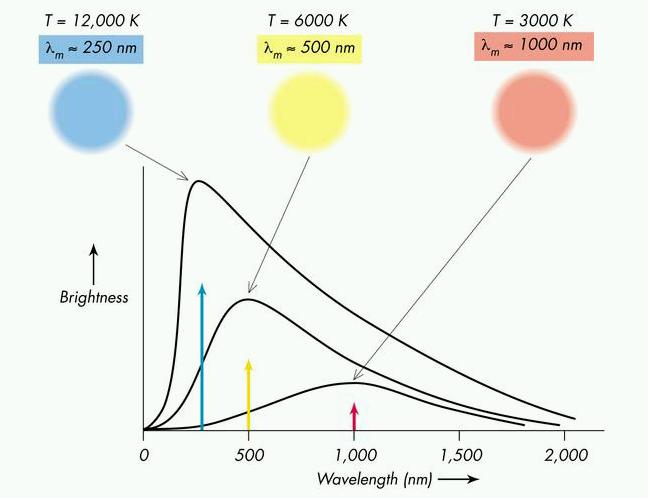
Thermal Radiation (Blackbody Radiation)
- A blackbody is an object that absorbs all the radiation falling
upon it. It is not "shiny", and it radiates in a broad spectrum,
characteristic of its temperature. (Q: Is a blackhole a blackbody?)
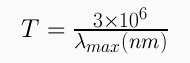
- Wien's Law: Hotter bodies radiate more
strongly at shorter wavelengths, i.e. "color" is an indicator of
temperature.
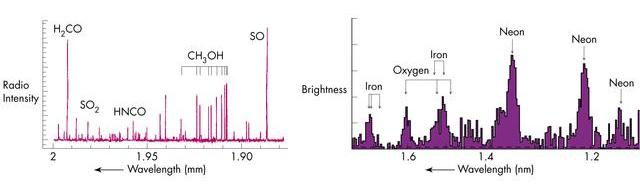
Spectral Line (Discrete) Radiation

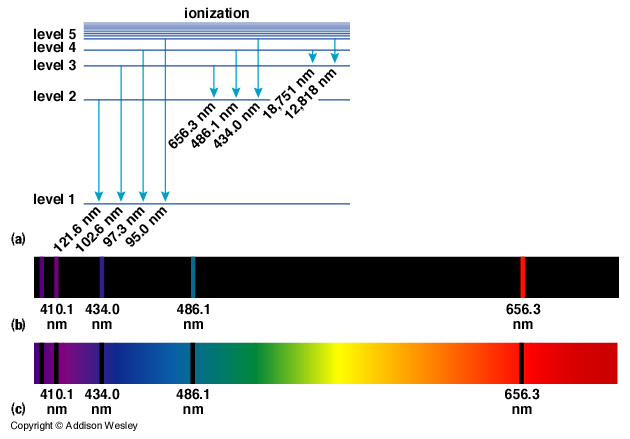
- Due to discrete atomic or molecular energy levels.
- Depends on quantum properties (e.g. electric charge, nucleon masses).
- An atom or molecule can both emit or absorb light in discrete
transitions, which are unique properties of each atomic or molecular
species.
Doppler Shift
- The spectrum of an object is the "strength of the light output" or
intensity from that object and the way this intensity varies with wavelength.
- Sometimes, this spectrum contains dark lines on a bright background (absorption spectrum) or
bright lines on a dark background (emission spectrum).
- These lines are at specific wavelengths characteristic of the chemical makeup of the object.
- So hydrogen has a specific set of lines, helium has a specific set of linesetc.
- See this link for more on Aborption and Emission Spectra
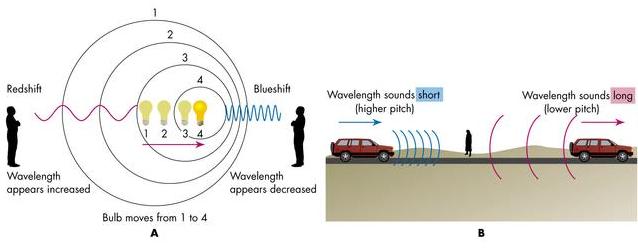
- Because of the Doppler effect, if the object is moving away from us,
these lines are shifted toward longer ie. redder wavelengths. If the
object is moving toward us, these lines are shifted toward shorter ie. bluer
wavelengths.
- So if you observed hydrogen lines in the spectrum of a distant galaxy,
but those lines had wavelengths shifted to the blue/red, you would
conclude that this galaxy is moving toward/away from us.
- This is the main reason why we believe the Universe is expanding.
- Spectral line from a light source shifts in wavelength with motion:
- High frequency (shorter wavelength) if moving toward you
- Lower frequency (longer wavelength) if moving away from you
- A measure of the line-of-sight speed (e.g. radar gun)


Quiz 7B: "This is Earth, Calling Luke Skywalker..."
Reading assignment for next lecture: Chapter 5 (p.130-p.151)